
Did You Know? WhatsApp Strips Location Data from Your Photos — And Why That Matters for Your Memories
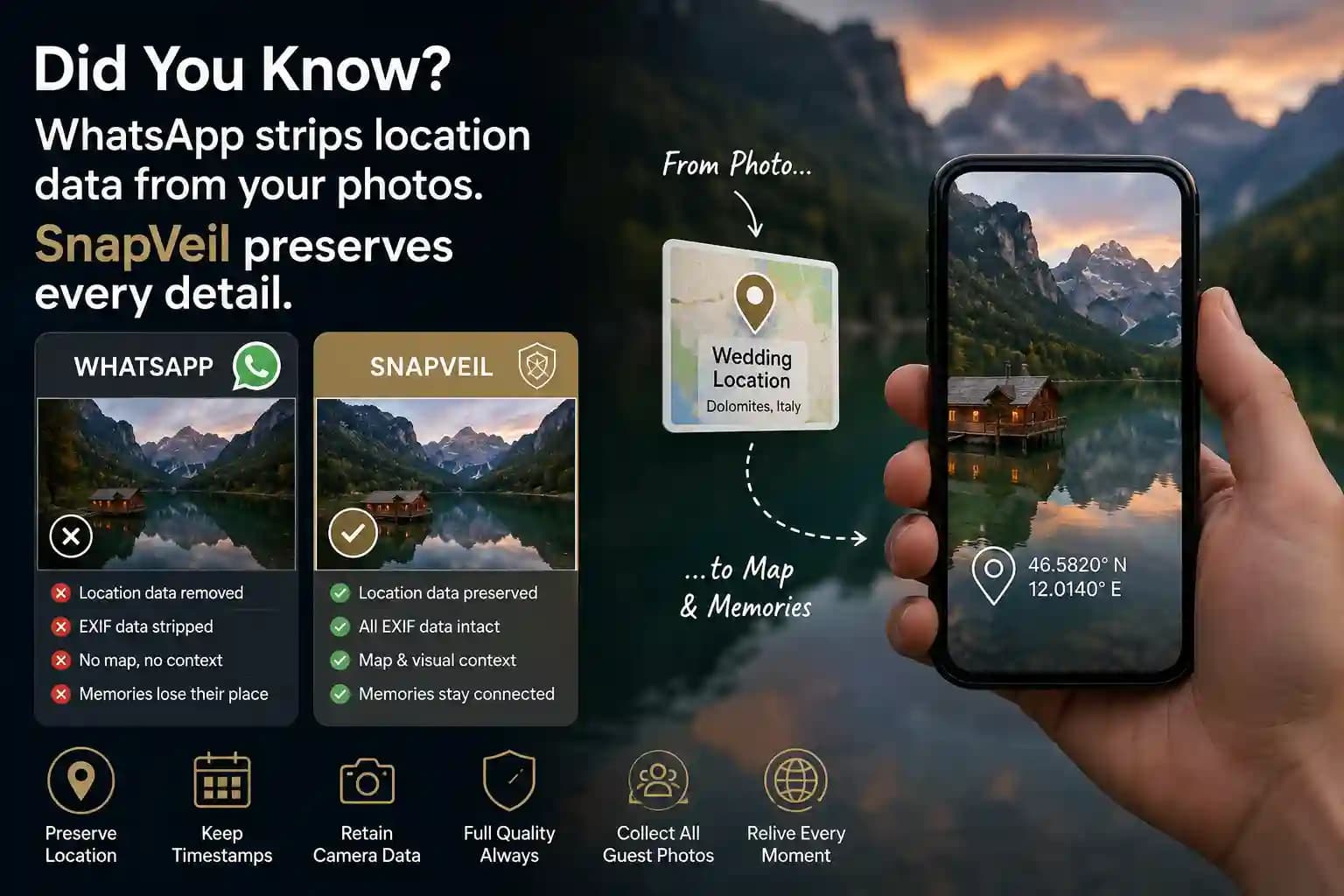
Most people assume that when they send photos via WhatsApp, everything about that image is preserved — including when and where it was taken. But here’s the surprising reality:
WhatsApp removes most EXIF metadata from images — including GPS location data.
That means the exact place where your photo was taken is lost the moment you share it. For casual chatting, that might not matter. But for meaningful moments — like weddings, travel, or once-in-a-lifetime events — this loss can be significant.
What Are EXIF Data and Why Do They Matter?
EXIF (Exchangeable Image File Format) data are hidden details stored inside every photo taken with a smartphone or camera. These include:
- 📍 GPS location (where the photo was taken)
- 📅 Date and time
- 📷 Camera and lens information
- ⚙️ Technical settings (ISO, exposure, etc.)
This metadata is what allows platforms like Google Maps or photo apps to automatically group, map, and visualize your memories. When EXIF data is stripped — as WhatsApp does — that entire layer of context disappears.
What exactly WhatsApp removes
Send a photo the normal way — the paperclip, then Gallery — and two things happen before it leaves your phone.
The image is re-encoded at a lower quality and smaller dimensions. A 4 MB photo typically arrives as a few hundred kilobytes. That is fine on a screen and visibly short of what a print needs.
And the EXIF block is stripped. Gone: GPS coordinates, camera model, lens, aperture, ISO, and in most cases the original capture time. What survives is the file itself and the time it was sent — which is not the same thing, and is why a wedding album assembled from WhatsApp sorts by when people got round to sending rather than by what happened when.
The one way around it
There is an exception, and it is worth knowing: send the photo as a document rather than as a photo. Paperclip → Document → Browse, then pick the image file.
WhatsApp then treats it as an arbitrary file and passes it through untouched — full resolution, metadata intact.
Two catches. It has to be done per file, every time, by every guest, and nobody will. And the recipient gets a file attachment rather than an image in the thread, so it is easy to miss and easy to lose.
It is a useful trick for one important photo. It is not a way to collect four hundred.
Why This Is a Problem — Especially for Weddings
Imagine this:
You get married at a stunning vineyard in Tuscany, a remote beach in Portugal, or a historic castle in Germany. Guests take hundreds of photos and share them via WhatsApp. Later, you try to:
- Revisit the exact ceremony location
- Create a visual timeline of your day
- Map your memories automatically
But you can’t — because the location data is gone. All those beautiful moments are now disconnected from the place they happened.
Snapveil: Preserving Every Detail That Matters
This is exactly where Snapveil changes the game. Unlike WhatsApp, Snapveil preserves all EXIF metadata, including:
- Full GPS coordinates
- Original timestamps
- Device and camera data
That means every photo keeps its full story intact.
From Photos to Interactive Memories
Because Snapveil retains location data, your images can be:
- 🗺️ Automatically mapped and visualized
- 📍 Revisited on platforms like Google Maps
- 🧭 Organized by real-world locations
- 🎉 Reconstructed into a complete event journey
For weddings, this is especially powerful:
You can relive your entire day — from preparation to ceremony to party — exactly where it happened.
Does this apply to other messengers too?
Mostly yes, with differences worth knowing:
- iMessage compresses by default but keeps more metadata within the Apple ecosystem. Send to an Android phone and it falls back to MMS, where quality collapses.
- Signal strips metadata deliberately — that is a privacy feature, not a defect, and it is doing exactly what it promises.
- Telegram offers a "send as file" option that is easier to reach than WhatsApp's, and keeps the original.
- Instagram and Facebook re-encode aggressively and strip everything. Anything that has been through a social platform has already lost it.
The pattern holds: any tool built for conversation optimises for speed and data use. Preserving your originals is not what it is for.
A Better Way to Collect Guest Photos
Snapveil is designed for modern events:
- Guests upload photos via QR code (no app needed)
- Full-quality images are preserved
- All metadata stays intact
- Everything is collected in one place
Instead of fragmented WhatsApp threads, you get a complete, structured, and meaningful photo collection.
WhatsApp vs. Snapveil — The Key Difference
| Feature | Snapveil | |
|---|---|---|
| Image Quality | Compressed | Original |
| EXIF Data | ❌ Removed | ✅ Fully preserved |
| GPS Location | ❌ Lost | ✅ Retained |
| Event Organization | ❌ Fragmented | ✅ Centralized |
| Memory Mapping | ❌ Not possible | ✅ Fully supported |
Why This Matters More Than You Think
Photos are more than just pixels — they are memories anchored in time and place. When you lose location data, you lose part of that story. Snapveil ensures that your memories remain:
- 📍 Geographically meaningful
- 🧠 Context-rich
- 🔄 Future-proof
Can you get the data back afterwards?
No. This is the part people underestimate.
Stripped metadata is not hidden, it is deleted. There is no setting, no recovery tool and no export that brings it back, because it is no longer in the file. Resolution is the same: the discarded pixels do not exist any more, and upscaling invents new ones rather than restoring the originals.
The only copy that still carries everything is the one on the photographer's phone — until they clear their camera roll, which on a phone that is always short of space happens sooner than you would think.
That is the real deadline. Not the wedding, and not the thank-you cards. The moment a guest frees up space.
Final Thoughts
Most people don’t realize that WhatsApp silently strips away the location data from their photos — until it’s too late. If you care about preserving your memories exactly as they happened, including where they happened, you need a solution built for that purpose.
Snapveil doesn’t just store photos — it preserves the full story behind them. See how it works for collecting wedding photos or read the guide on sharing wedding photos.
Related Articles
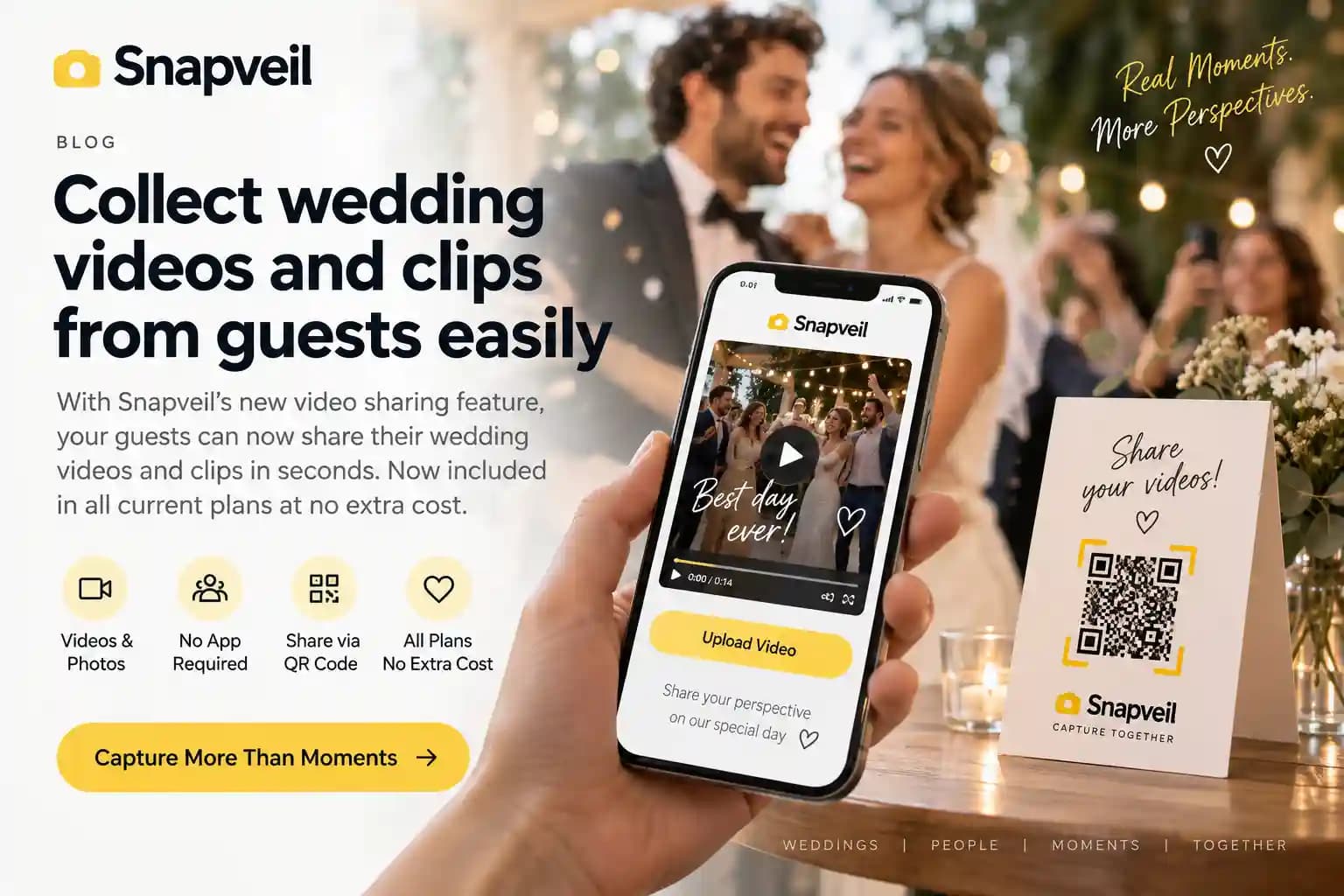
New Video Upload Feature for Snapveil Wedding Galleries (Free Update)
Collect wedding videos and clips from guests easily with Snapveil's new video sharing feature. Now included in all current plans at no extra cost.
Read article
Photo Booth Software for Weddings in 2026: Options and Costs
Rent, iPad app or DSLR rig? What photo booth software really costs for one wedding, where every booth falls short, and what to do about it.
Read article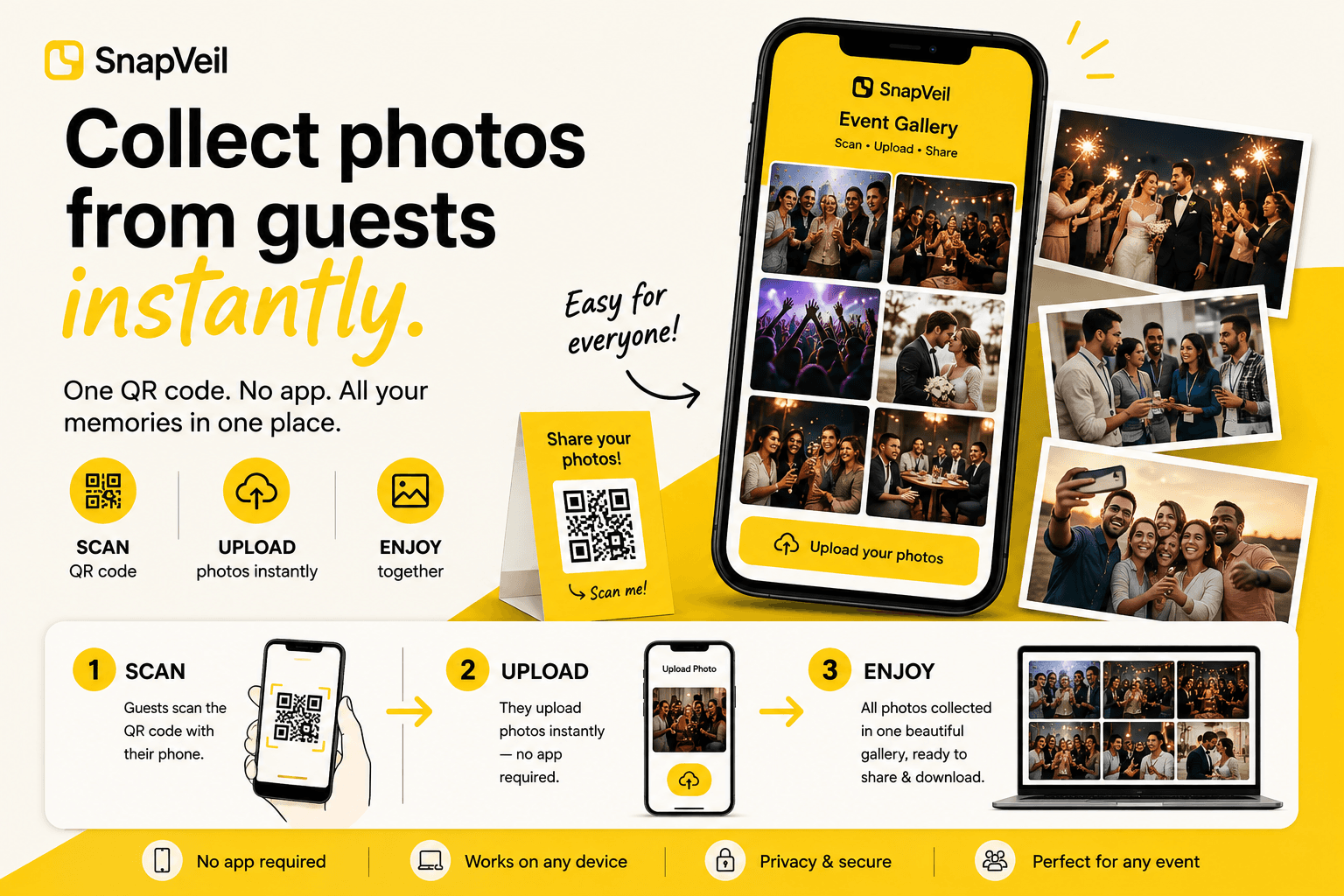
How to Set Up a QR Photo Gallery in 5 Minutes
One QR code, one private gallery, guests upload from the browser. A five-step tutorial from creating the gallery to downloading everything afterwards.
Read article