
Disposable Cameras at Weddings: Cost, Tips and the Digital Alternative
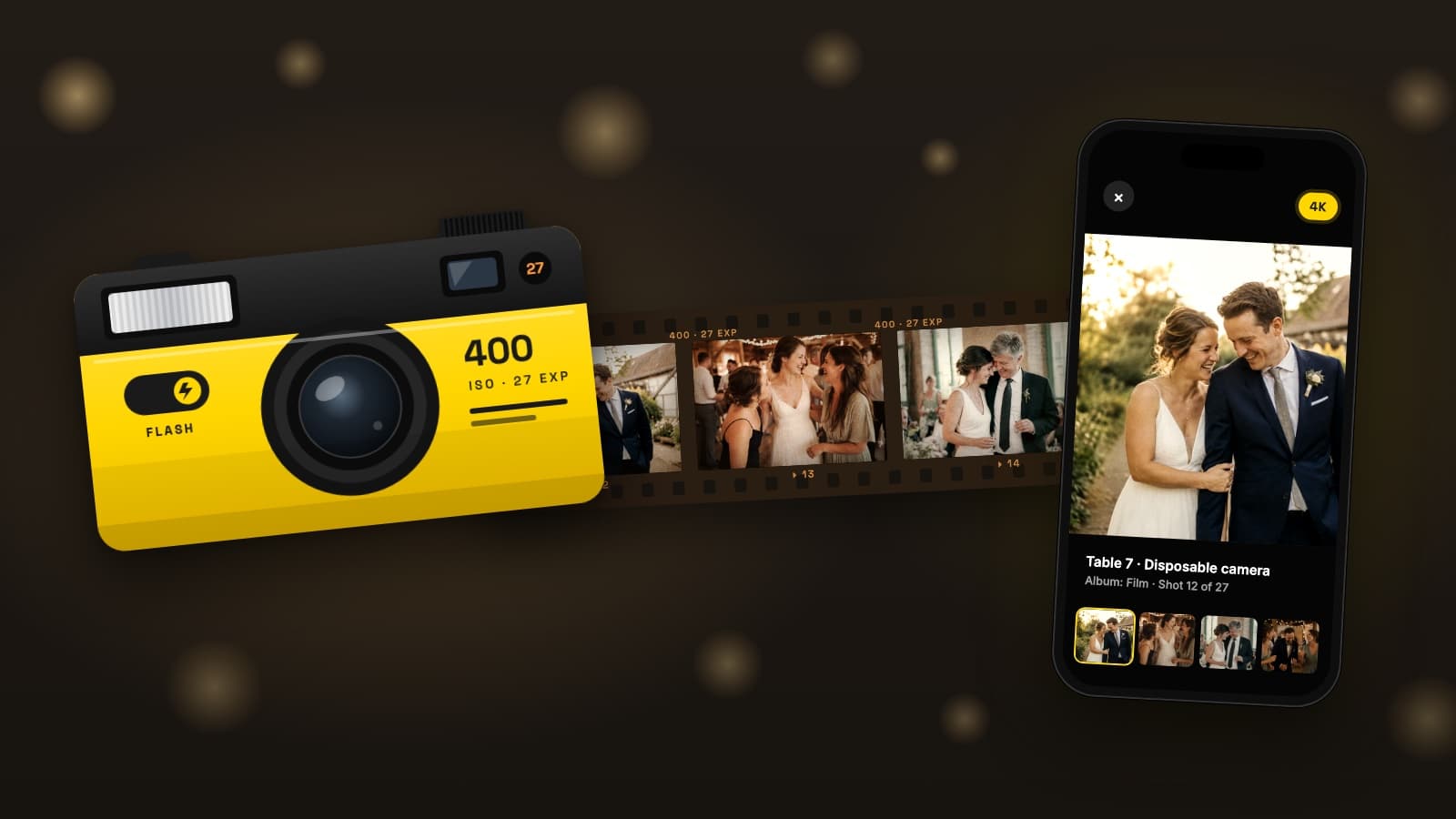
A yellow disposable camera on every table, with a little note: "Capture the night for us." The idea is charming, and it has a catch nobody talks about before the wedding: some of the pictures come out too dark, blurry or show the tablecloth. You only find out weeks later, when the films come back from the lab.
This article explains what disposable cameras can and cannot do at a wedding, what they cost, how to get the most out of them and when a digital gallery is the better choice. At the end you will find a way to combine both.
Why disposable cameras are so popular at weddings
The main reason is the look. Film has grain, warm colors and a flash that lights faces harshly while the background falls into darkness. That style is back in demand at weddings, especially with couples who are tired of perfectly retouched photos.
Then there is the surprise. Nobody sees the pictures beforehand, there is no deleting and no second try. When the prints come back, it feels like a small second wedding day. The cameras are also a talking point at the table, particularly for older guests and kids who take fewer photos with a phone.
What disposable cameras can and cannot do
A typical disposable camera such as the Fujifilm QuickSnap Flash has an ISO 400 film with 27 exposures. The manufacturer gives the flash range as 1 to 3 meters, and the focus starts at one meter. Other models have more shots, for example the Kodak FunSaver with 27 plus 12, so 39 exposures.
Those numbers explain the typical problems at a wedding:
- In a large hall at night, the flash reaches the next table at most. Everything behind it turns black.
- Selfies at arm's length are closer than one meter and come out blurry.
- On some models the flash has to be switched on again before every shot. Forget it indoors and the picture is dark.
- There is no preview. A thumb over the lens only shows up at the lab.
None of this means disposable cameras take bad pictures. Outdoors in daylight, and with flash at short distances, you get exactly the photos you bought them for. You just need to know where the limits are.
How much disposable cameras cost for a wedding
In German drugstores, disposable cameras with flash currently start at around €14, and a Kodak FunSaver with 39 exposures costs €17.99 at Rossmann (October 2026). Then there is developing, ideally with scans so you also have the pictures digitally. Prices for that vary by lab and service, so ask before the wedding. Drugstores such as dm and Rossmann accept disposable cameras for developing.
A quick calculation: with ten tables and one camera each, the cameras cost you roughly €140 to €180, plus developing ten films. In return you get at most 270 pictures, if every camera has 27 exposures and every one of them is used. If a camera comes back half full or shots fail, you get fewer.
How many disposable cameras do you need?
One camera per table is the usual choice. For long banquet tables or many guests per table, two can make sense. More cameras do not automatically mean more pictures, because a camera nobody picks up stays empty. Having someone keep an eye on the cameras matters more than the number.
Tips for better disposable camera photos
Put a small card next to each camera with three tips: always switch on the flash, keep a distance between one and three meters, and use up the whole film. It sounds obvious, but it prevents most failed shots.
Give the cameras a job. Instead of "take whatever you like", a concrete list helps, for example our 50 wedding photo scavenger hunt ideas. Then you do not get 27 pictures of the same table.
Pick one person to collect all the cameras at the end of the night. Otherwise disposable cameras end up in handbags, jacket pockets or the bin. Number the cameras so you know whether they all came back.
Order high-resolution scans when you have the films developed. Prints alone are lovely for an album, but without scans you can neither share the pictures nor back them up.
Disposable camera or digital gallery compared
Snapveil is our own product. The comparison is still meant to be fair, because both options have their strengths.
| Disposable camera | QR code gallery | |
|---|---|---|
| Pictures | 27 to 39 per camera | as many as guests take |
| When you see them | after developing | right away, during the party |
| Dark rooms | flash reaches 1 to 3 meters | phone cameras cope better with low light |
| Look | real film grain | however the phones shoot |
| Work afterwards | collect, develop, scan | none, the pictures are already in the gallery |
A QR code gallery works like this: a code sits on the tables, guests scan it and upload their phone photos straight from the browser, with no app. You have every picture in one place and in original quality instead of chasing them one by one after the wedding. Our page on QR code photo sharing shows how it works.
What a gallery cannot give you is the surprise. With Snapveil, photos appear right away for all guests. If waiting for the film is exactly what you want, no app replaces a disposable camera.
The best of both: film scans in the gallery
You do not have to choose. A good setup is to place disposable cameras on a few tables as an accent and let every guest upload by QR code as well. When the scans come back from the lab, upload them to the same gallery. Then phone photos and film shots live in one place, and every guest sees both.
A few things make this easier in Snapveil. Create a separate album for the film shots, called "Film" for example, so the scans do not get lost among the phone photos. The gallery can be sorted by date taken, upload time or file name. For scans, file name is usually the best choice: the stored capture date of a scan is normally the day it was scanned, not the wedding day, whereas labs usually number the files in sequence, which keeps the order of the film.
So the grain does not get lost, Snapveil Pro and Ultra also store new photos in up to 4K. On a large screen or when you zoom in, every detail stays visible, even the grain of film photos. That needs scans with a high enough resolution: no gallery makes a small scan bigger.
On numbers: the free plan covers 250 photos. Ten films with 27 shots each are already 270, before a single phone photo. Pro is a one-time €29.90 per event and includes unlimited photos (fair use), original-quality downloads, twelve months of storage and the live photo wall for projector and TV. For more on gathering every guest's pictures, see our page on how to collect wedding photos.
Conclusion
Disposable cameras give you a look no phone can copy, but only a few pictures per camera and plenty of misses in the dark. As an accent on a few tables they are a lovely idea. As the only source of your guests' photos they are a gamble. Combine both and put the scans into a shared gallery afterwards, and you get the charm of film and every picture of the night.
Frequently Asked Questions
Related Articles
Wedding Guest Book Ideas: 30 Creative Alternatives Your Guests Will Use
30 wedding guest book ideas: classic books with a twist, keepsakes to hang, interactive stations, digital options and prompts for your guests.
Read article
Wedding Photo Scavenger Hunt: 50 Photo Challenge Ideas for Your Guests
50 wedding photo scavenger hunt ideas, sorted by the flow of the day, plus how to run the game so every guest photo ends up with you.
Read article
Share Wedding Photos Instantly with QR Codes (No App Needed)
Stop chasing guest photos! Let guests upload wedding pictures instantly via QR code—simple, fast, and perfect for capturing every moment.
Read article