
SD vs HD vs Original: Choosing Your Export Quality for Event Photos
SD vs HD vs Original: Choosing Your Export Quality for Event Photos
Every wedding photographer has heard some version of this story: a guest photo turns out to be the emotional centerpiece of the day — grandma laughing mid-toast, the ring exchange caught from an angle the official photographer missed — and then it turns out the file is 800 pixels wide, stripped of every detail, and useless for anything beyond a phone screen.
Export quality isn't a technical footnote. It's the difference between a photo you can print, edit, and archive — and one you can only scroll past.
If you're choosing a gallery platform, or trying to explain to a couple why their guest photos matter, understanding the real differences between SD, HD, and Original exports will save you a lot of frustration later.
Why Export Quality Is Not One-Size-Fits-All
Not every photo needs to be a 45-megabyte RAW-adjacent file. A guest sharing a quick shot to a group chat doesn't need the same file as a photographer building a wedding album for print. The smartest gallery platforms let you choose the right quality tier for the right job — instead of forcing everyone into the same compressed default.
Here's how the three tiers typically break down.
SD, HD, and Original: A Side-by-Side Comparison
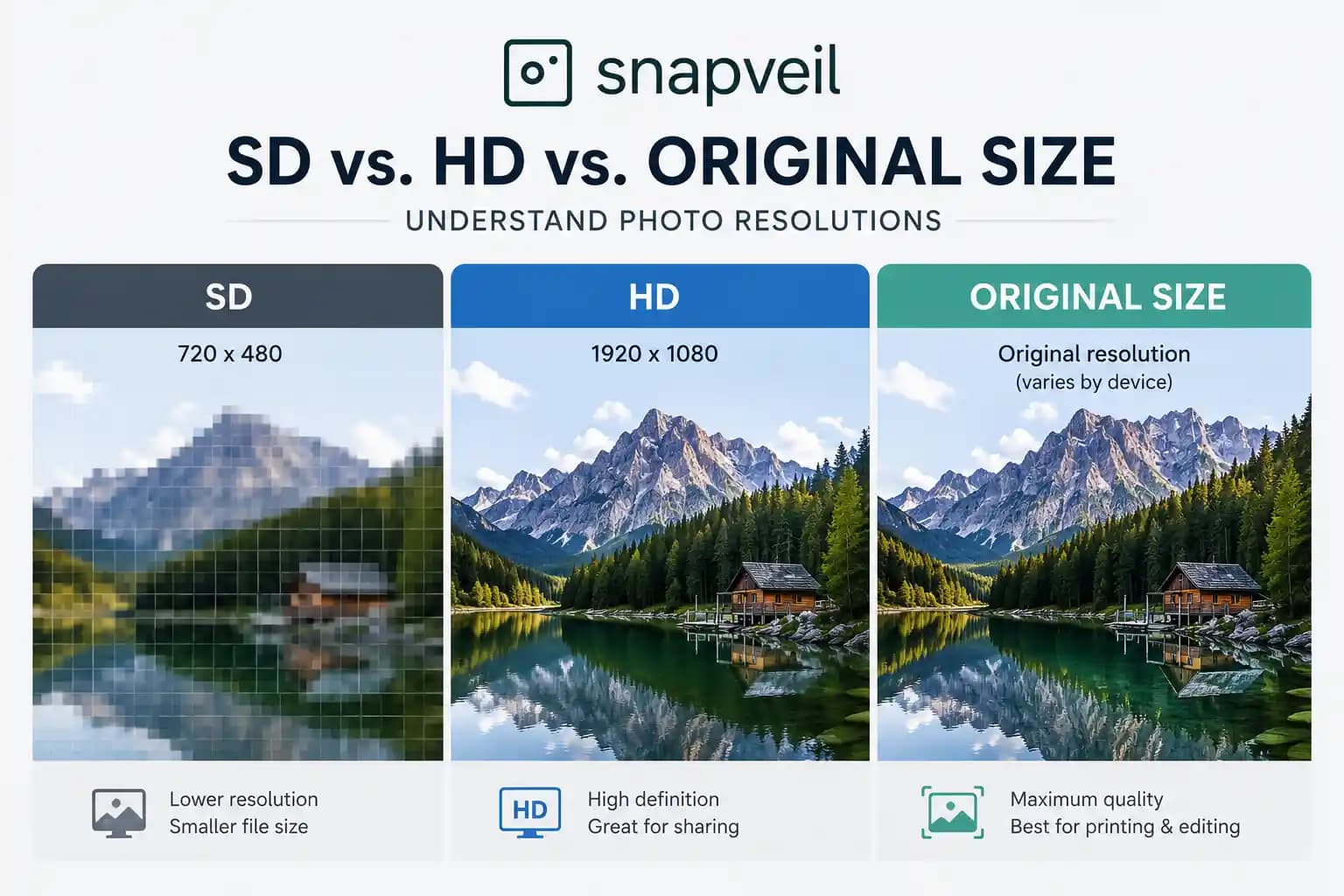
SD (Standard) HD (High Definition) OriginalTypical resolution Up to ~1080px wide Up to ~2048–4000px wide Full sensor resolution (as captured) File size Small (a few hundred KB) Medium (1–5 MB) Large (5–50+ MB depending on camera) Metadata retained Often stripped Partially retained Fully retained (EXIF, timestamps, camera settings) Best for Social sharing, quick previews, messaging apps Digital albums, screen displays, casual prints up to A4 Professional printing, retouching, archival, legal/insurance records Ideal user Guests sharing casually Couples building a digital keepsake Photographers, professional editors, official event organizers
The pattern is simple: as the stakes go up — print size, editing depth, long-term storage — the need for full resolution and intact metadata goes up with it.
Why Metadata Matters as Much as Resolution
Resolution gets all the attention, but metadata is often the more costly thing to lose.
When a photo is exported with its metadata intact, it carries:
EXIF data — camera model, lens, aperture, shutter speed, ISO. Essential for photographers reviewing technical quality or replicating a look. Timestamps — the exact capture time, which matters enormously when sorting hundreds or thousands of guest photos into a coherent timeline of the day. Color profile information — needed for accurate color reproduction when a photo goes to print. Copyright and attribution tags — increasingly important for platforms and photographers who want to credit contributors properly.
Strip the metadata, and you strip the ability to sort, verify, or professionally reproduce the image. A folder of 2,000 guest photos with no timestamps is a sorting nightmare. The same folder with metadata intact can be organized chronologically in seconds — which matters a great deal once you're trying to export photos with metadata into an editing workflow rather than just look at them.
Real Scenarios: Which Tier Do You Actually Need?
You're a wedding photographer building the final album. You need Original. Nothing less will hold up to print-size cropping, color grading, or client scrutiny. And you need the metadata intact so you can sort guest contributions alongside your own captures by actual capture time, not upload order.
You're an event organizer archiving photos for legal or insurance purposes. Original, every time. A compressed, metadata-stripped photo has less evidentiary value — you want captured-at timestamps and unaltered files.
You're a couple who just wants a digital keepsake to scroll through and share. HD is usually the sweet spot — full-looking images without unnecessarily large files clogging up a phone.
A guest wants to post a candid shot to their Instagram Story. SD is fine. Nobody needs a 40MB file for a nine-second story.
The mistake many platforms make is assuming everyone needs the same tier — either overcompressing everything (frustrating photographers) or exporting everything at full size by default (frustrating guests who just want a quick, shareable file).
Common Mistakes That Cost Photographers Later
Exporting SD by accident and losing print rights value. If a client wants a large-format print six months later and all you have is an 800px file, there's no fixing that after the fact. Assuming metadata survives every export. Many consumer-grade sharing tools strip EXIF data automatically for privacy or file-size reasons — which is great for guests, but a real problem if you needed that data for sorting or verification. Not checking export settings before the event. The best time to confirm your gallery's export tier defaults is before doors open, not after 300 guests have already uploaded photos.
How SnapVeil Handles Export Quality
SnapVeil was built around the idea that photographers and organizers shouldn't have to choose between guest convenience and professional-grade output. That's why galleries support tiered exports — SD, HD, and Original — so each person downloading photos gets the right file for their purpose.
For photographers and organizers specifically, SnapVeil preserves full metadata on Original exports, and supports mass download of an entire event gallery as a single organized archive — no manual, one-by-one saving required. Because SnapVeil is entirely web-based, there's no app for guests to install — they simply scan a QR code, and the platform is built with GDPR compliance in mind from the ground up, which matters increasingly for professional photographers working with EU clients.
Whether you're pulling a full gallery into Lightroom for post-processing or just want to confirm that timestamps and camera data survived the export, the goal is the same: no surprises when you open the files.
The Bottom Line
Export quality isn't just a technical setting — it's a decision about who your photos are for and what they'll be used for next. SD works for quick, casual sharing. HD covers most everyday digital use. Original, with full metadata intact, is non-negotiable for anyone doing professional work, printing, or archiving.
Choosing a gallery platform that lets you set the right tier — rather than forcing a single compressed default on everyone — is what separates a smooth post-event workflow from a frustrating one.
Ready to see the export options in action? Explore a live SnapVeil gallery demo and see exactly how SD, HD, and Original exports work — metadata intact, no app required.
Related Articles
# Photobooth Software: Then vs. Now — and What to Choose Today
Photobooth software has evolved dramatically over the past two decades. What once required custom-built setups, DSLR cameras, and one-time software purchases has now shifted toward user-friendly, mobile-first solutions and subscription-based platforms. While modern tools offer more features, flexibility, and ease of us
Read article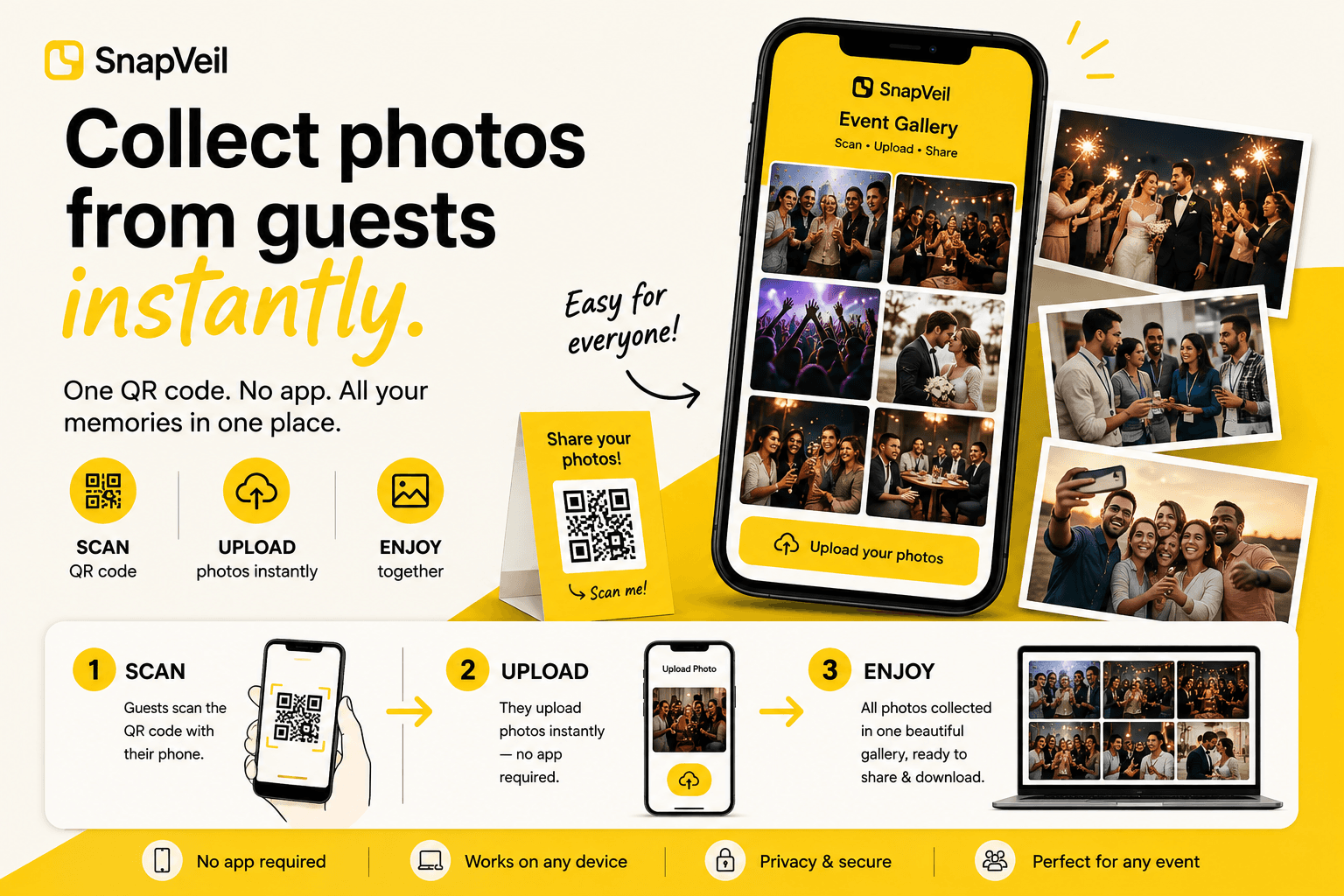
How to Set Up a QR Photo Gallery in 5 Minutes Collecting photos from guests used to be messy—endless WhatsApp groups, lost uploads, and low-quality files
This step-by-step tutorial shows you exactly how to **start a free event photo gallery**, get guests uploading within seconds, and deliver a seamless experience for weddings, corporate events, and parties.
Read article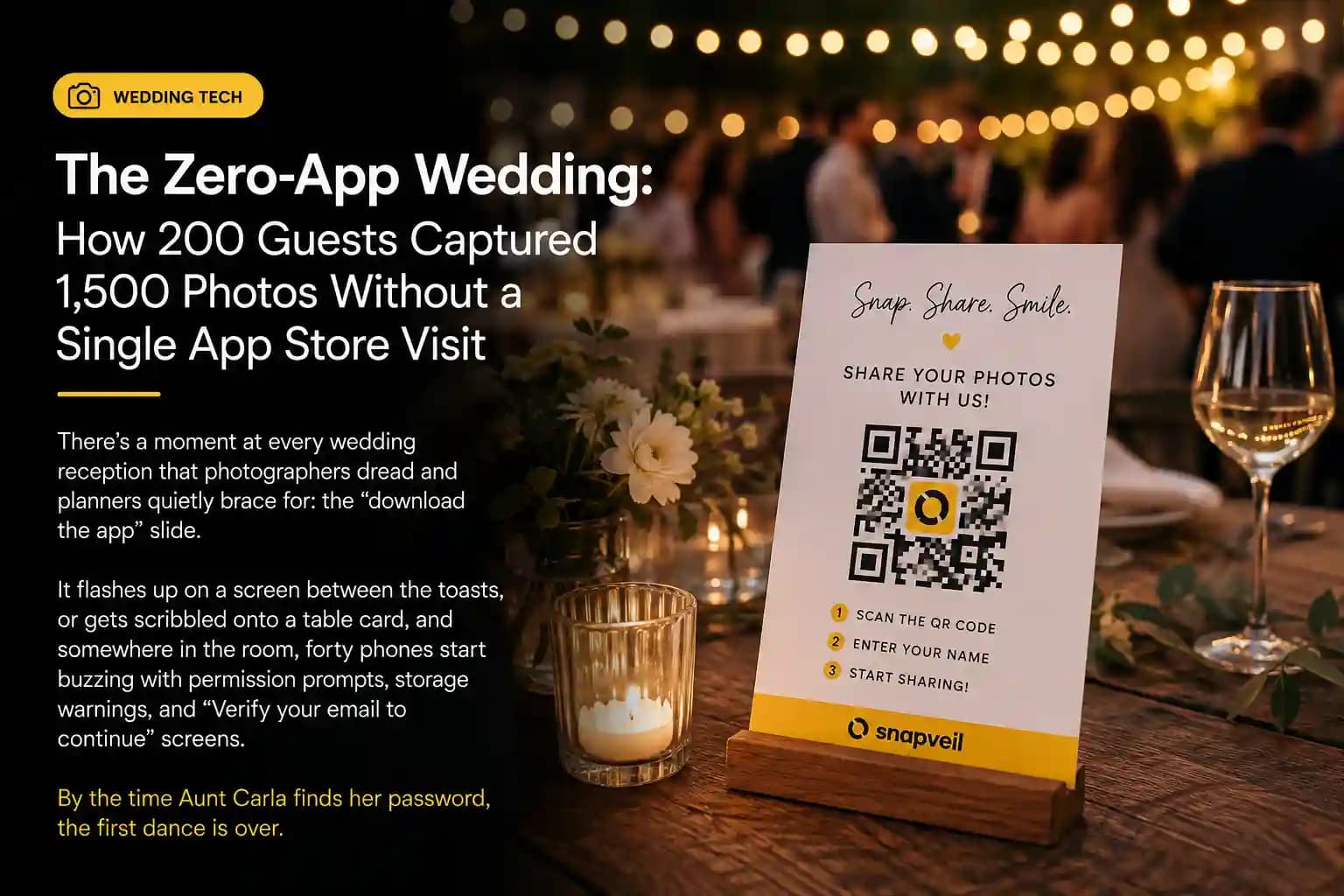
The Zero-App Wedding: How 200 Guests Captured 1,500 Photos Without a Single App Store Visit
200 wedding guests. 1,500 photos. Zero app downloads — here's how one wedding outside Münster proved that the biggest barrier to great guest photography was never technology, it was the download screen.
Read article