
Modern Event Photography Meets Privacy: Why Shared Photo Apps Are Changing the Game
Modern Event Photography, Privately Shared — Snapveil.com
Introduction: A New Era for Event Photography
Event photography has always been about capturing a moment before it disappears. But the way those moments are collected, shared, and stored has changed dramatically over the last few years. What used to mean a single photographer with a camera and a USB stick full of files now means dozens of guests contributing photos from their phones, professional shots being delivered digitally within hours, and everyone expecting instant access to a shared gallery before they've even left the venue.
This shift has created enormous convenience — but it has also introduced a problem that many event organizers, photographers, and hosts overlook until it's too late: privacy. When a hundred guests are uploading photos of each other, of children, of private conversations, and of personal moments to a shared platform, who controls that data? Who can see it? How long does it stay online, and can it be deleted?
This is where the intersection of event photography, photo sharing, and data protection becomes one of the most important considerations for anyone planning or documenting an event in 2026. Choosing the right shared photo app or event app isn't just a matter of convenience anymore — it's a matter of responsibility.
It's also worth clearing up a common misconception before we go further: Snapveil is not a downloadable app at all. It's a fully web-based photo gallery — guests simply open a link or scan a QR code in their browser, with nothing to install and no account required. That web-first approach isn't just more convenient; it's also central to how Snapveil handles privacy, since there's no app permanently sitting on a guest's phone with standing access to their camera roll, contacts, or location. Combined with GDPR-compliant data handling by design, it's an approach built specifically for the concerns raised throughout this article.
The Rise of Shared Photo Apps in Event Photography
A decade ago, event photography was a one-way street. A hired photographer took pictures, edited them over the following weeks, and eventually delivered a gallery link or a disc. Guests had no way to contribute their own perspective, and any candid moments captured on personal phones stayed scattered across group chats, never gathered in one place.
Shared photo apps changed that entirely. Today, a wedding, corporate conference, birthday party, or product launch can have a single, centralized gallery where every guest can upload their own photos in real time. A QR code on a table card or a simple link shared in a group chat is often all it takes. Within minutes, dozens of different angles, candid expressions, and behind-the-scenes moments start appearing in one place — moments the official photographer might never have caught.
This democratization of event photography has real benefits:
- Completeness: No single photographer can be everywhere at once. Guest contributions fill in the gaps.
- Authenticity: Candid phone photos often capture genuine emotion that posed professional shots miss.
- Speed: Photos appear in the shared gallery instantly, rather than being sent around individually or waiting weeks for a final edit.
- Connection: Guests feel more involved in documenting the event rather than simply attending it.
But this convenience comes with a tradeoff that too many event apps ignore: the more people who can upload, view, and download photos, the more exposed personal data becomes — and the more important it is that the underlying event app was actually built with privacy in mind.
What Makes a Great Event App in 2026
Not all shared photo apps are created equal. Many were built primarily to be flashy, feature-heavy, or fast to launch, with privacy treated as an afterthought — a checkbox rather than a design principle. A genuinely modern event app needs to balance three things simultaneously: ease of use, high-quality photo handling, and strong data protection.
1. Frictionless Access Without Sacrificing Control
Guests shouldn't need to create an account, download a heavy app, or remember a password to contribute to an event gallery. The best solutions are entirely web-based: guests tap a link or scan a QR code, land straight in a browser gallery, and start uploading in seconds — no App Store detour, no install, no storage taken up on their phone. This also gives the event host meaningful control over who can join, who can view, and who can download, without relying on guests to keep an app updated or even to have space left on their device.
2. High-Resolution, Reliable Uploads
Event photography lives and dies by image quality. A good event app needs to handle high-resolution uploads from a mix of smartphones and professional cameras without compressing memories into blurry, pixelated thumbnails. Reliable upload performance — even over spotty venue Wi-Fi — is non-negotiable.
3. Real-Time Organization
With potentially hundreds of photos flooding in from multiple sources, a shared photo app needs smart organization: chronological sorting, face-based grouping, or tagging by moment (ceremony, dinner, dancing) so the final gallery doesn't become an unsorted mess.
4. Built-In Privacy Controls
This is the piece too many platforms get wrong. A modern event app should let hosts decide:
- Who can view the gallery (public link vs. invite-only access)
- Whether guests can download original, full-resolution files
- Whether uploaded photos are automatically deleted after a set period
- Whether facial recognition or automatic tagging features are enabled — and whether guests can opt out
- Where the data is actually stored, and under which legal jurisdiction
These aren't nice-to-have extras. They are the foundation of responsible event photography in an age where a single leaked gallery link can expose dozens of people's images to strangers.
Photo Sharing and the Privacy Problem Nobody Talks About
Here's the uncomfortable truth: most guests uploading photos to a shared event gallery have no idea what happens to that data afterward. They snap a photo, tap upload, and move on with their evening. Few people stop to ask:
- Is this photo stored on a server in a country with weak data protection laws?
- Can the platform use uploaded photos for marketing or AI training without consent?
- Will this gallery still be publicly accessible in five years?
- Can a stranger who finds the link download and redistribute these photos?
These questions matter more than ever, especially for events involving children, sensitive corporate information, or simply people who value their privacy. A birthday party photo of someone's kid, a private toast at a wedding, an internal product demo at a corporate event — none of it should end up indexed by search engines or sitting unprotected on a server indefinitely.
This is precisely why photo sharing platforms built for events need to think beyond "make uploading easy." They need to build privacy by design — a principle where data protection isn't bolted on afterward but is part of the architecture from day one. This includes:
- Encryption of photos both in transit and at rest
- Time-limited galleries that automatically expire or require renewal
- Consent-based access, so only invited guests — not the entire internet — can view or download images
- No unauthorized use of uploaded content for advertising, AI training, or third-party sharing
- Clear, simple deletion options so hosts and guests can remove their own contributions at any time
For event planners and photographers working in the EU, this isn't optional — it's a legal obligation under the General Data Protection Regulation (GDPR). Every photo containing a recognizable person is considered personal data, and organizers who use a shared photo app without verifying its compliance can find themselves legally responsible for a data breach they didn't even know occurred.
Why This Matters More for Weddings and Personal Events
Weddings are perhaps the clearest example of why privacy-conscious event photography matters so much. A wedding gallery isn't just professional portraits — it's dozens of guests uploading candid shots throughout the night: private family moments, the couple's first dance, close friends letting loose on the dance floor, children running around in ways their parents might not want posted publicly.
Couples increasingly want a way to:
- Give guests an easy way to contribute photos without demanding they download a heavy app
- Keep the resulting gallery private, accessible only to people who were actually invited
- Avoid photos ending up on public social media without consent
- Give guests clear instructions and a simple, welcoming experience so uploading feels like part of the celebration, not a chore
This is where a well-designed event app built specifically for occasions like weddings outperforms generic photo-sharing tools. A generic app might be built for broad, public sharing. A purpose-built event photography app is built around the assumption that most galleries should default to private, that consent matters, and that the people in the photos deserve a say in what happens to their image.
The Photographer's Perspective: Collaboration, Not Competition
Professional photographers sometimes worry that guest-uploaded photo apps will make their work less relevant. In practice, the opposite tends to be true. A shared gallery for guest photos and a professional's curated, edited portfolio serve different purposes, and the best events combine both.
Photographers benefit from shared photo apps in several concrete ways:
- Handoff efficiency: Rather than manually collecting memory cards or waiting for a separate upload process, photographers can integrate their final edited galleries into the same event app guests are already using, creating one unified experience.
- Client trust: Offering couples or corporate clients a privacy-respecting, professional gallery experience — rather than a public, ad-supported photo dump — is a meaningful differentiator in a competitive market.
- Reduced liability: When the platform itself handles consent, access control, and data retention properly, photographers are less exposed to disputes over unauthorized image use.
Forward-thinking photographers are increasingly building privacy-conscious shared photo apps into their service offering as a value-add, not a threat to their business model.
A Practical Checklist for Choosing an Event App
Whether you're a couple planning a wedding, a corporate event manager, or a professional photographer recommending tools to clients, here's a practical checklist for evaluating any shared photo app before committing to it:
- Where is data stored, and under what legal framework? Look for GDPR-compliant hosting, ideally within the EU. Our own approach is described under GDPR event photos.
- Is the gallery private by default? Public-by-default platforms are a red flag for personal events.
- Can guests upload without creating a permanent account? Frictionless participation matters, but it shouldn't come at the cost of data control.
- Does the platform allow full deletion of photos and personal data on request?
- Is there a clear retention policy? Photos shouldn't live forever on a server without the host's knowledge or consent.
- Does the platform use uploaded images for marketing, training AI models, or any purpose beyond the event itself? Read the fine print.
- Is there a simple way to control who can download full-resolution originals versus who can only view compressed previews?
- How is the gallery shared — via public search-indexable links, or via secure, invite-only access?
Any platform that can't answer these questions clearly and transparently isn't ready to handle the personal, sometimes deeply intimate photos that come out of real events.
Looking Ahead: The Future of Event Photography
As more of life's biggest moments are documented collaboratively by dozens of smartphone cameras rather than a single professional, the demand for smart, secure, and genuinely private event photography tools will only grow. Guests want simplicity. Hosts want beautiful, complete galleries — the kind you can create in a few minutes. Photographers want tools that complement rather than complicate their workflow. And increasingly, everyone involved wants assurance that their images aren't sitting unprotected somewhere on the internet.
The platforms that succeed in this space won't be the ones with the flashiest filters or the fastest upload speeds alone — they'll be the ones that treat privacy as a core feature, not an afterthought. A truly modern shared photo app gives hosts full control over their event's memories: who contributes, who can see the results, how long the gallery stays live, and what happens to the data when it's time to let it go.
Event photography, at its heart, is about preserving moments that matter. The tools we use to do that should honor the trust guests place in us every time they hit "upload" — protecting not just the photo, but the people in it.
Looking for an event photo gallery that puts privacy first without sacrificing a beautiful, easy sharing experience for your guests? Snapveil is a web-based, GDPR-compliant alternative to traditional event apps — no download required, nothing to install, just a simple link that turns into a private, secure gallery for everyone involved. That's exactly the balance modern event photography should strike: simple enough for every guest to use, and secure enough that hosts never have to worry about where their memories end up.
Related Articles
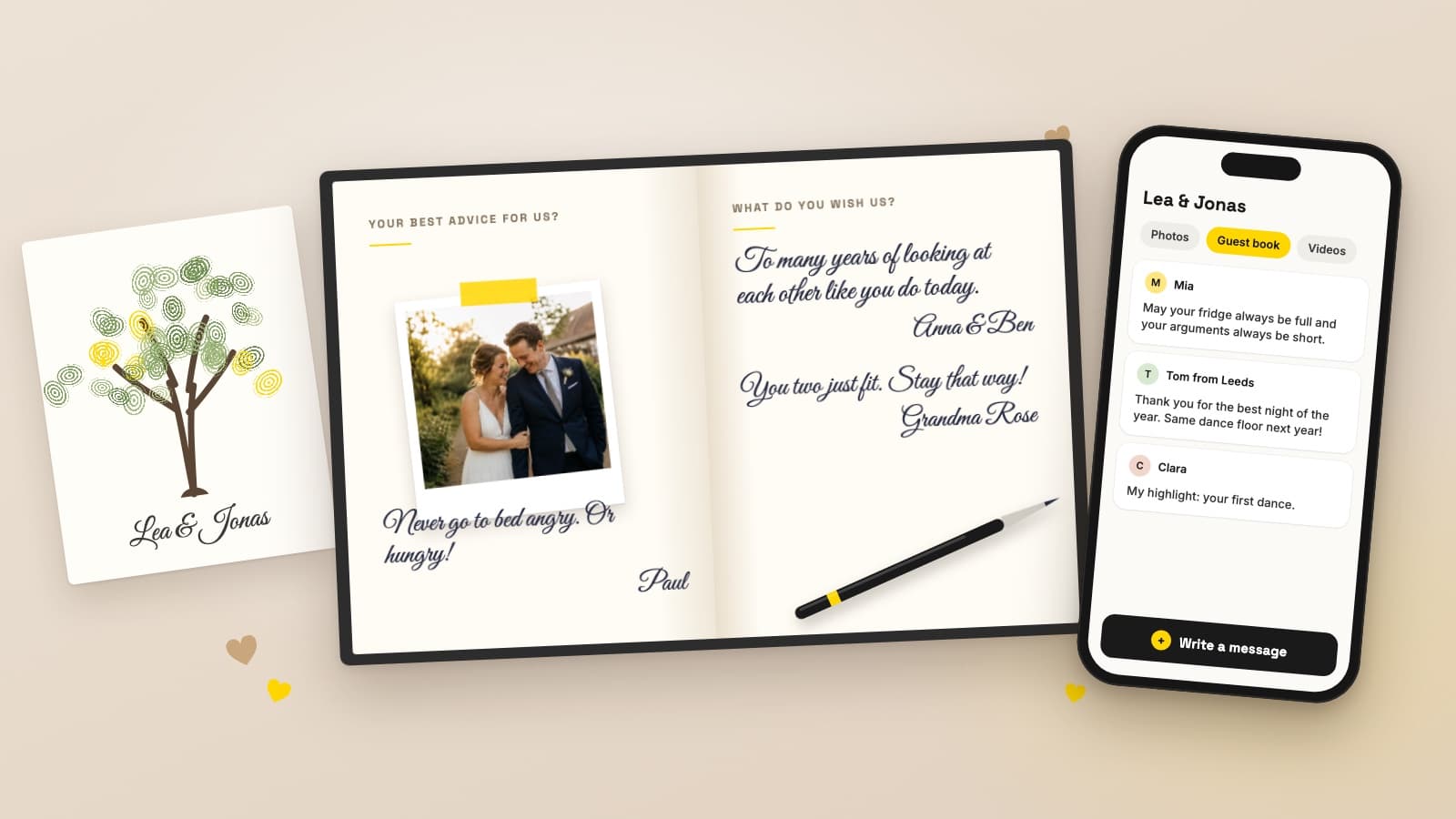
Wedding Guest Book Ideas: 30 Creative Alternatives Your Guests Will Use
30 wedding guest book ideas: classic books with a twist, keepsakes to hang, interactive stations, digital options and prompts for your guests.
Read article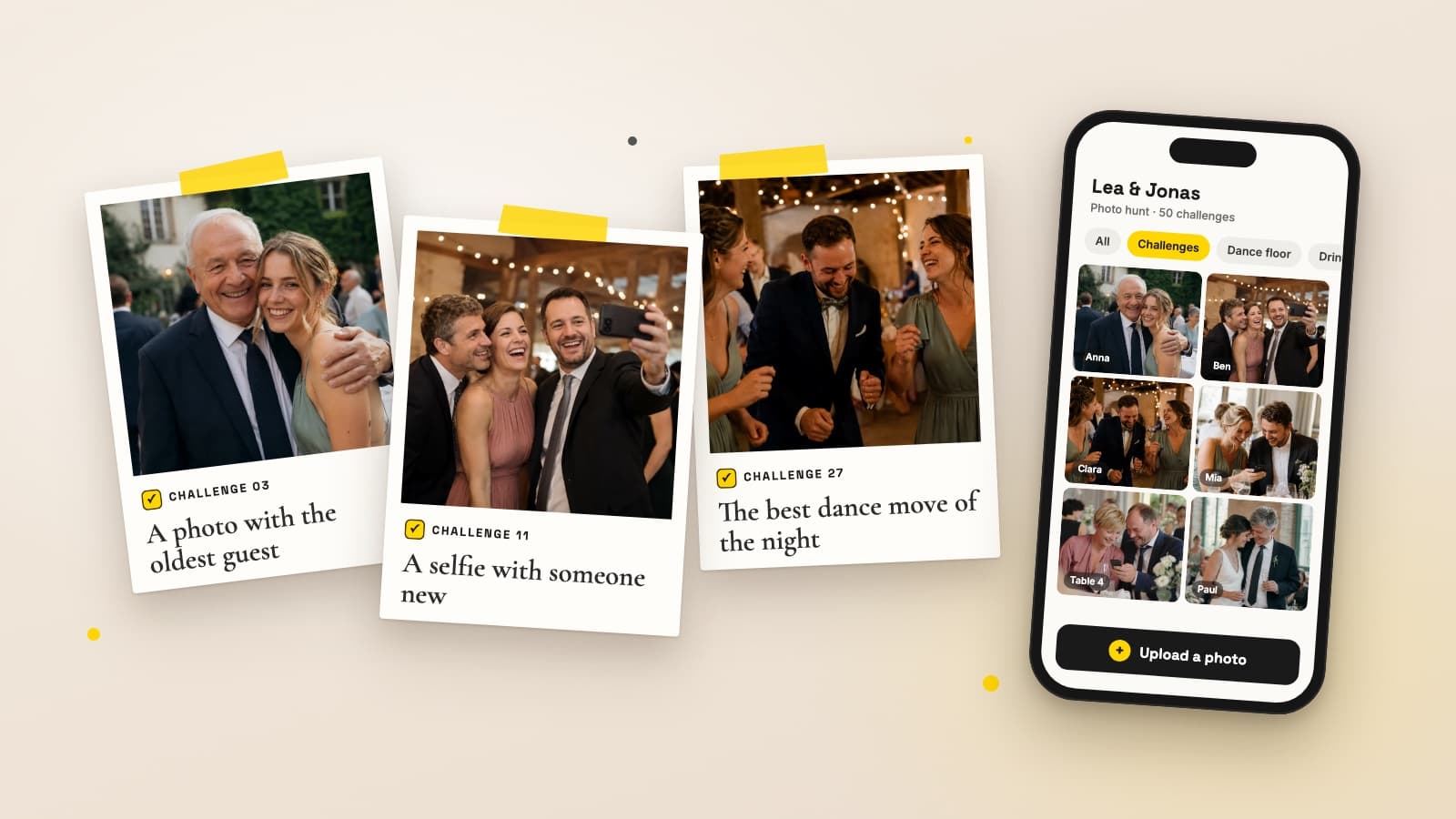
Wedding Photo Scavenger Hunt: 50 Photo Challenge Ideas for Your Guests
50 wedding photo scavenger hunt ideas, sorted by the flow of the day, plus how to run the game so every guest photo ends up with you.
Read article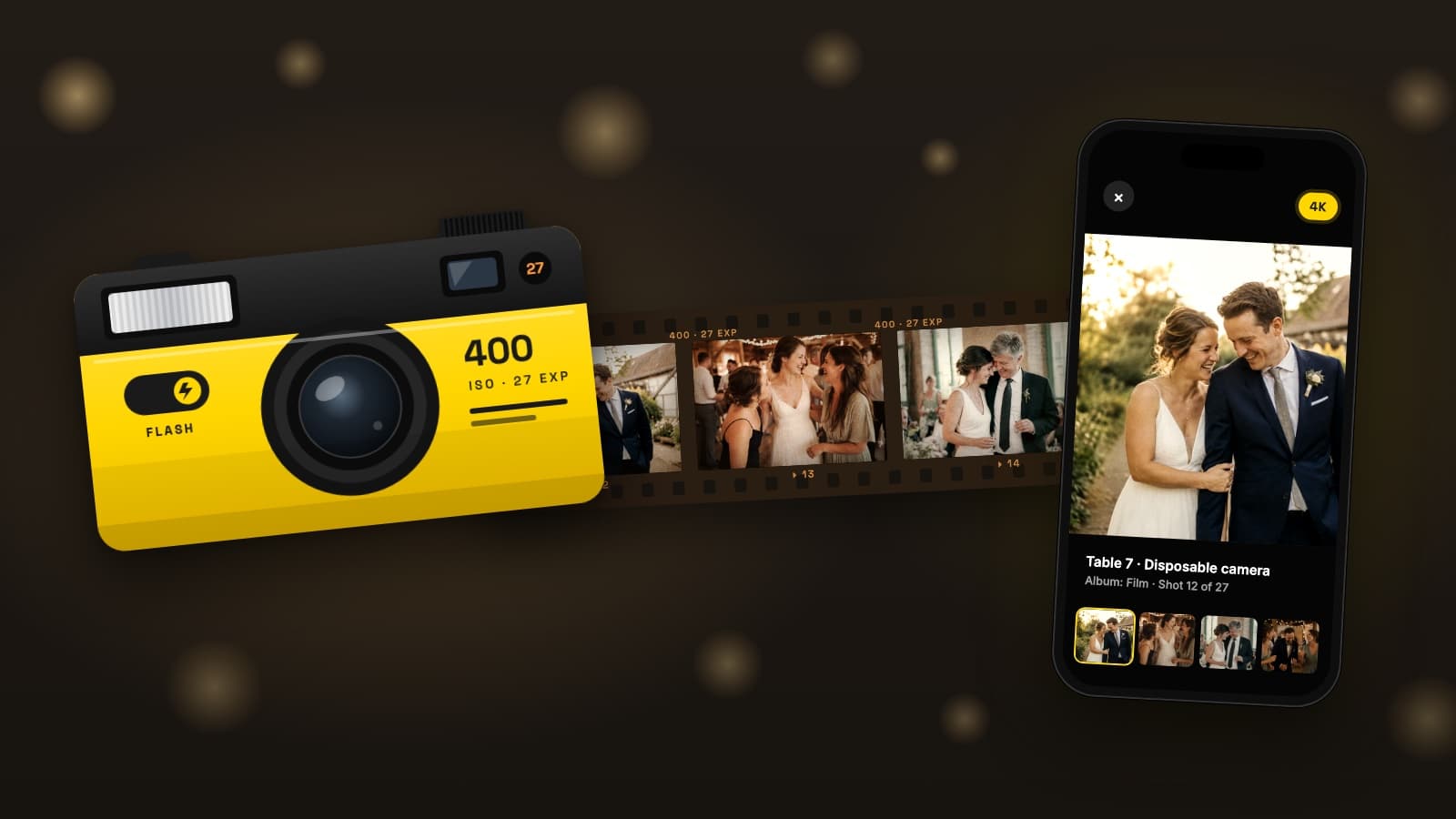
Disposable Cameras at Weddings: Cost, Tips and the Digital Alternative
What disposable cameras really deliver at a wedding, what they cost, how to get better shots and how to combine film scans with a QR gallery.
Read article